Book Review: Cryptonomicon
[md]September 04, 2025
I first read Cryptonomicon back in college. The book impressed me by introducing me to all kinds of weird ideas, from Linux nerdery, to the first seeds of cryptocurrency, to the optimal way to enjoy Captain Crunch, to the general gist of World War II cryptography.
Revisiting Cryptonomicon in 2025 wasn't quite as fun. All of the tech startup bits left me with a bad taste in my mouth: I think a lot of it is supposed to be satire, but the humor falls flat the same way that the TV show Silicon Valley falls flat these days. When tech companies are actively destroying so much of our world, it's hard to appreciate the satire.
It was still fun to see how Neal Stephenson intertwines historical WW2 fiction with 'modern day' (well, 2001) technology. But overall Cryptonomicon dragged a lot more than other recent Stephenson books, and I think it's mostly because the book simply hasn't aged that well.
Introduction #
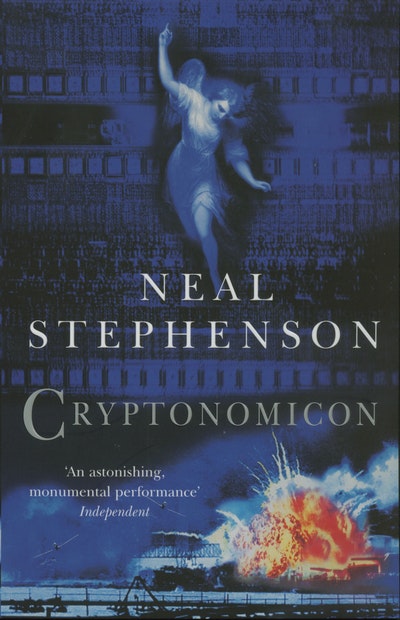
Cryptonomicon is an awfully long book split across two plots: one in WW2, one around 2000. Many characters from the 2000s plot are descendants (or older versions) of characters from the WW2 plot. There are vague connections between the two plotlines, but honestly a lot less than you'd think.
Characters #
-
Randall (Randy) Lawrence Waterhouse: a 'modern day' (when the book was written, at least) computer nerd, stuck in a crappy relationship, who has only one good friend. But that friend routinely sweeps Randy up in tech startups that are just a few steps away from Ponzi schemes.
-
Lawrence Prichard Waterhouse: a 1940s computer nerd, a cryptographer working for the US military. Randy's grandfather.
-
Bobby Shaftoe: a Marine who becomes gradually more unhinged as his PTSD unfolds throughout the book.
-
Enoch Root: a magical man who is always in the right place at the right time, whether it's an island of aboriginals in the Pacific Ocean, a small town in Sweden, or a jail cell in the Philippines. Immortal, I guess? Allegedly appears in Neal's Baroque Cycle books, but plays a surprisingly large part in the story of Cryptonomicon.
Sadly, Cryptonomicon doesn't spend much time establishing female characters other than having them occasionally sleep with the male protagonists. The romance plotlines are truly pathetic: everyone is either a spy who seduces a protagonist, or an object of affection who miraculously winds up interested in the nerdy protagonist despite their fumbled attempts at seduction. I'm not sure if Bobby's girlfriend, Glory, ever says anything at all. And Amy Shaftoe, who ought to be a full-blown protagonist, gets sucked into the object-of-affection gravity of Randy and ceases to be an interesting character.
Plot #
The story of Cryptonomicon is all over the place.
In the WW2 era, it's straightforward enough: codebreakers break codes. A top secret task force completes operations to try to obfuscate the fact that the Allies have broken most of the Axis codes. This plotline contains the best parts of the book, mostly revolving around Lawrence breaking codes and misunderstanding the world around him because he's clearly on the spectrum. Bobby's chapters are sometimes funny, often in a too-slapstick way, but also frequently degrade into incoherent PTSD nightmares. Sometimes it's hard to tell the difference between the slapstick bits and the nightmare bits.
The 'modern' (2001-ish) plotline follows a tech startup attempting to build a high-security vault of encrypted data, safe from government tampering, on a fictional Southeast Asian island nation. Despite spending absurd amounts of time describing Randy's walks around Manila, we never really get a good explanation of why this vault is a good idea, how their company (who doesn't even own the vault, they just own data connections to and from the vault) plans to make money, or what all of these high tech employees are actually up to every day.
Eventually Randy stumbles upon some old WW2-era encrypted communications that he decrypts in a Filipino prison while possibly being Van Eck phreaked. And for some reason nobody simply threatens him with a hammer to get information out of him. Those communications contain information about a secret Japanese cache of gold in the mountains of the Philippines, which somehow causes the entire plot to somersault into a plan to create a cryptocurrency, based on the value of the gold, which everyone seems to believe will prevent future genocides.
Based on events in 2025, I'm growing increasingly skeptical that cryptocurrencies will ever help prevent genocides. But maybe I'm just being cynical.
Setting #
What works? World War II is full of interesting technology, like U-boats and radar and Enigma machines and huffduff and Catalinas. It's a rich tapestry for a story.
Modern Southeast Asia provides lush jungles, corrupt governments, and wildly exotic cityscapes (from the very poor to the absurdly rich). But it sometimes feels as though Neal isn't taking full advantage of that environment. If this entire story took place in the USA, it wouldn't have to change that much. Most of the modern plot is driven by subterfuge and lawyers, sometimes in thrillingly nonsensical ways (Andrew Loeb, missing a foot, with a bowie knife, deep in the jungle, anyone?). So the location truly doesn't matter, and sometimes actively interferes with suspension of disbelief, as it very much does during Randy's time in prison.
Summary #
I don't think I would recommend Cryptonomicon today. It's not a bad book, but the long, dated rambles about technology, the out-of-touch and vaguely offensive portrayals of Southeast Asia, the utter lack of compelling female characters, and the creepy romance plotlines really add up. Back when Bitcoin was new, before it was completely co-opted by radical right Ponzi schemers, the sloppy storytelling around cryptocurrency was novel and kind of fun. These days? It's just depressing. And I think everyone is pretty sick of stories about tech startups and lawyers at this point.
The WW2 historical fiction plotline would be decent on its own. Maybe not Neal's best work, but compelling if you enjoy the WW2 era.
All in all, Cryptonomicon is like a bowl of wet Captain Crunch: it won't hurt you, but it might be frustrating to think about how it ought to be so much better.