Book Review: The Diamond Age
[md]October 22, 2025
The Diamond Age: Or, a The Young Lady's Illustrated Primer has gotten a lot of attention lately in the tech community. That's largely a result of one very important object: the Primer itself, which is basically an interactive Hitchhiker's Guide to the Galaxy-esque ereader, but with physical, turn-able pages that rewrite themselves. The Primer was specifically designed to teach a young woman leadership skills and a hacker ethos, but it also includes the ability to monitor and teach the reader basically anything it deems necessary for survival, including how to kill someone with a screwdriver.
So the Primer is basically a personal tutor for every single professional and personal domain. You can see why AI-everything techies love the idea. What if every child got a personal tutor that could pay attention to them at all times, never get distracted, never sleep, never take time off, with deep knowledge about every subject area a child could ever hope to study?
Of course, those AI enthusiasts have missed perhaps the most important takeaway from the entire book.
Introduction #
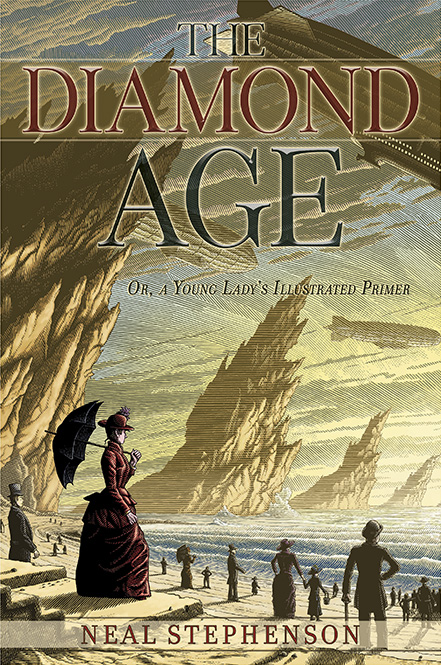
In The Diamond Age, Neal Stephenson attempts to explain how, by sexually transmitting sufficient quantities of nanobots through underwater orgies, we might be able to overcome IP law and usher in the end of classism, advertising, borders, and child endangerment.
But in the end, despite all of the technology, hacking, and geopolitics, love turns out to be the essential (missing) ingredient.
Also, I guess if enough people take off their clothes and link hands, they can float over a really big chunk of ocean.
TL;DR: Like most Neal books, it's complicated.
Characters #
- Nell: our hero, a good-hearted kid from a rough neighborhood, the offspring of a the first character who Neal kills in the entire book
- Harv: older brother of our hero, honorable and kind enough to protect her, but not strong enough to save himself
- Miranda: former Victorian private tutor, then (re)actor, then actor; kind-of sort-of adopted mother/teacher for Nell, via voice acting contracts generated by the Primer; Neal forgets to give her arc any kind of ending whatsoever, besides condemning her to years of hivemind orgies and an eleventh hour rescue from the hivemind right before she is killed (but not ritualistically, it's part of an extremely long-term computation devised by Hackworth to invent a technology called The Seed, which is also... sort of dropped in the final chapters of the book)
- John Percival Hackworth: lovable, brilliant, but quite imperfect Victorian dad; disappears for over a decade because Doctor X tricks him into joining an undersea hivemind orgy (so he can invent The Seed, which barely matters in the plot of the book)
- Judge Fang: my favorite character, NYC born and raised, moved to the-landmass-formerly-referred-to-as-China to be a Judge, his scenes provide some of the only helpings of comedy in Part I, as he and his surprisingly well-characterized posse navigates the mysterious connection between the Primer, Dr X, and Hackworth
- Doctor X: spooky man who uses a posse of ghetto kids to collect and research nanotechnology and occasionally mug Victorians; also might be running the world's largest oceanfaring organ farming operation; also a master of calligraphy; also immensely well connected to Inner China (the 'Celestial Kingdom')
- Constable Moore: Nell's only real father figure, who Neal also coincidentally fails to provide any kind of arc for; a Scottish war veteran with serious PTSD, serious chops on the bagpipes, and a strong moral compass
- Carl Hollywood: Miranda's boss, but mostly a ridiculous teenage boy's fantasy fulfillment of 'good guy with a gun, in a duster jacket'; essentially a knockoff Clint Eastwood/Malcolm Reynolds mashup
The cast is sprawling by early Neal standards; I haven't even covered any side characters here. Characterization is strong, especially in Part I. Look no further if you're yearning for good characters.
Setting #
In The Diamond Age, Neal Stephenson imagines a medium-near future (>100 years, <1000 years) for humanity at a startling level of detail. Zeppelins roam the earth. Nanotechnology enables nearly infinite levels of technical detail and design finesse. Remember how concrete completely transformed architecture and we wound up with brutalism? In The Diamond Age, nanotechnology takes that upheaval to the next level. Ubiquitous at-home and public 'matter compilers' have solved hunger (if you like gruel) and resource scarcity (if you are content sleeping in a free matter-compiled blanket on a beach instead of a house or apartment). But matter compilers are entirely dependent on a highly centralized energy source called The Feed. Individual phyles and geographic regions have their own Feeds, but as far as I can tell, running a Feed is sort of like running a nuclear reactor in 2025: expensive, messy, potentially dangerous, and generally only dabbled in by billionaires, corporations, nation states, or terrorists.
Of course, this technology has a dark side. Though perhaps not as strong a dark side as a cynical person might imagine in the year 2025. Most formulae in the matter compiler are gated behind paywalls. Advertising on electronic holographic billboards, combined with eye-tracking cameras, has made for a truly dystopian environment. Nanotechnology has resulted in a proliferation of 'mites' -- microscopic floating nano-devices -- in the air in every major urban environment. Sometimes those mites go to war with each other, and simply walking outside coats your clothes (and lungs) in black dust, the remains of billions of disintegrated mites.
Countries and borders may no longer exist (truly a utopian idea, from the perspective of 2025), but 'phyles' have replaced them in the minds of the people, if not in physical contiguous boundaries. The Victorian phyle gets a lot of attention throughout the book, being comprised of neo-Luddites who eschew distasteful tech and ascribe to a set of values almost (but not quite) like those of real-world 1800s Victorians.
While nanotechnology has made anything possible in the physical world, AI is remarkably simplistic. "Reactive" immersive virtual reality entertainment requires human actors for quality voice and emotional acting. Even the Primer itself, one of the most advanced pieces of technology in the entire book, requires a human 'ractor' back-end for narration.
To top it all off, a lot of people are not content with this world. Especially in the geographic space that used to be China. Especially in Part II, Neal explores the consequences.
Neal does a great job of fleshing out the good and bad parts of this world. Especially early on, chapters are full of deep, detailed descriptions of nanotechnology, society, and politics. But there are some odd Neal quirks to this universe. Notably: a strange amount of Part II involves people getting naked, even when it seems completely unnecessary (during an interactive comedy performance on an abandoned cargo ship near London?). And maybe I'm underestimating the human capacity for violence, but good lord are people absolutely ready to throw down and fight to the death at any time in this world.
The Primer #
As I hinted at before, the Primer has gotten a lot of attention since LLM chatbots became a thing. "We're so close to creating the Primer from The Diamond Age and revolutionizing education," chants the overenthusiastic crowd of Hacker News commentators as they ready their angel investment portfolios for the Next Big Thing.
In the Diamond Age, the Primer is just not that special. Sure, it comes up with enthralling fantasy stories for a kid. Sure, those fantasy stories have educational and moral subtext based on the context of the user. But in the end, only Nell and Fiona Hackworth get much out of their Primers, because they both received love and attention from consistent, individual ractors: for Nell, Miranda, and for Fiona, her father. Every other Primer-girl relationship falls flat because it's missing an essential ingredient: love. Both Nell and Fiona can tell that behind the Primer, a human being exists with investment in their life and development. Elizabeth loses interest in her Primer because she has two real parents and plenty of tutors to dote on her at all times; every girl in the Mouse Army learns to become a cog in a machine thanks to their cheap non-racted Primers. But none of them develop a relationship with their Primer because in the end it's just a soulless machine.
In reality, just the ability of the Primer to spin educational fairy tales based on the life of the user would be an amazing development. But for most users it wouldn't differ much from the traditional puzzle-solving video games that we've had for decades now. To get anything better than those video games, you need something else. Intention. Socratic dialog. And maybe love?
Plot #
Like many Neal books, The Diamond Age is massively frontloaded with worldbuilding. You have to slog through quite a few chapters before you get a firm grasp on the world he's trying to describe. Personally, I found The Diamond Age a bit easier than most Neal books to get into: it's just close enough to the current day dystopia that you don't have to stretch your imagination too far to imagine nanobots swirling in the air, surveillance tech and targeted ads on the street, and neo-Luddites. Just replace our current software dystopia for a hardware dystopia, and imagine a secular, slightly fancier version of the Amish, and you're most of the way there!
Unlike most Neal books, The Diamond Age swaps between the real world and a collection of fantasy stories devised by the Primer. These stories feature characters inspired by real world associates of Nell, and follow a classic hero's journey arc: Princess Nell must complete a series of challenges to collect a series of keys to open a lock and save her brother, Harv. As real world Nell survives and escapes the ghetto, attends a Victorian school, and eventually sets off on her own journey in life, the Primer creates and extends challenges to teach her life lessons and leadership. Early on, the Primer does simple things like teach Nell how to read. Later, the Primer teaches her much more specific lessons, like the concept of a universal Turing machine.
When I first read the book, I had recently completed a broad swath of introductory computer science classes. The Castle Turing bits and conversations about encryption and data science all enthralled me. At this point in my life, those concepts feel a bit old hat, so those same sections honestly bored me a bit. Your experience will likely vary on your level of understanding of those concepts; if you don't know what a Turing machine is, you'll be confused; if you sort of know what a Turing machine is, you'll wind up enthralled; if you know what a Turing machine is and you've been working in tech without using that knowledge for a decade, you might be a little miffed.
Aside from the Princell Nell Primer story, The Diamond Age follows a few different major characters around future China and the Pacific Northwest. Doctor X conspires. Hackworth bumbles. Nell impresses people around her by being more competent than an actual princess and Hackworth's daughter, the only other young women with fancy Primers that use voice (re)actors.
The end of the book is a complete mess. Somewhere in there, I can detect thought-provoking ideas about decentralization, groupthink, the proper way to raise a child, and the (doomed?) concept of the nation state. But it's all lost in a giant drawn-out messy war-porn rape bloodlust denouement. Neal halfheartedly capstones arcs every chapter or two. None of them wind up particularly satisfying.
Summary #
The Diamond Age has the most rushed ending of any Neal book ever. He doesn't even attempt to tie up loose ends, and the last 5 chapters are nothing but gratuitous war-porn and deux ex machina. It truly feels like he wrote a good book for a while, he wanted to buy a new house, and he just... slapped an ending on it so could submit it to his publisher to cover his deposit or something. Doctor X, CryptNet, the Drummers, Miranda's storyline, all just... stop.
Personally, I choose to imagine this as something like Firefly: cancelled before its time. The characters and the world are still enjoyable, but don't expect a satisfying story arc. A classic Neal Stephenson novel, but not my favorite.