Book Review: Anathem
[md]August 06, 2025
"Our opponent is an alien starship packed with atomic bombs," I said. "We have a protractor."
"Okay, I’ll go home and see if I can scrounge up a ruler and a piece of string."
"That’d be great."
I first read Anathem back in high school. I liked it a lot, but found it a challenging read.
Revisiting Anathem this year, I liked it even more. It only took a day and a few dozen pages to wrap my head around the invented words using context clues, linguistic inference, and foggy memories of my first read over a decade ago. I couldn't quite remember where the plot went, but I was able to summon a couple of basic plot points from my memory banks. Turns out, that made the first half of the book even more suspenseful!
Still interested? Read on for a detailed explanation of what I liked and disliked! I'll try to keep the bulshytt to a minimum.
Introduction #
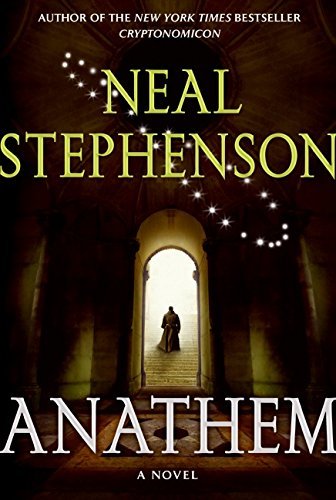
Anathem isn't an easy sci-fi (or should I say spec-fic, speculative fiction?) read. Stephenson draws from philosophy, linguistics, computer science, logic, math, geometry, astronomy, physics, quantum mechanics, sociology and probably a lot more that I missed. The plot takes some time to get going, and Stephenson (as per usual) spends a lot of time on indulgent tangents. But the plot is brilliant. I found the vast majority of the tangents interesting. The characters are compelling. And I can't help but be impressed by the sprawling, imaginative world (or should I say cosmi?) that Stephenson created.
If you like hard science fiction or fantasy and wish more books would challenge you, I highly recommend Anathem. It's not as abstract or challenging as, say, Book of the New Sun. But you could say the books are... similar Narratives.
If you want a relaxing read you can pick up for a few minutes every night before bed, don't bother with Anathem. Especially the first 100 pages or so throw a lot of invented language, exposition, setting establishment, historical references, and characters at you, and Stephenson doesn't exactly go out of his way to hook you into the book until page 200 or so. You kind of have to love worldbuilding to bother.
Minor spoilers below. Major spoilers are hidden unless you explicitly choose to reveal them.
Setting #
Imagine a world where you didn't have to participate in today's "information economy." What if there were special places, kind of a combination of university and monastery, where you could live in isolation from modern technology -- smartphones, short-form video, social media, 24 hour news, and advertisements? Places where everyone spent their time studying sciences like math, logic, linguistics, and algorithms. Places that provide shelter, food, and support, so you don't even have to worry about saving for retirement or paying rent? Where even the food is simpler, lacking artificial preservatives and additives, since 'maths' grow their food in a completely self-sufficient way?
If you're anything like me, you might enjoy the fantasy of living as an avout on Arbre. Think of it as something akin to the childhood fantasy of getting an invitation to Hogwarts on your eleventh birthday -- while you know magic doesn't actually exist, there is a strong allure to the idea of escaping from this pedestrian, suburban, car-dependent, money-grubbing dog-eat-dog existence we've cooked up for ourselves. I would describe the first half of the book as "Hogwarts, but grad school". Stephenson's imaginative and somehow derogatory invented terms make this fantasy even more enticing:
- jeejah: smartphone -- the portrayal of which is even more impressive given the fact that this book was published in 2008, within a year of the release of the first iPhone
- sline: uneducated person
- bulshytt: slimy, evasive corpo- or politician-speak, but also generally any meaningless statement
- extras: anyone who does not live in a math, instead residing extramuros (outside the walls)
- mathics: resident of a math who lives intramuros (inside the walls)
There are a lot more invented terms than this -- for more examples, see the 20 page glossary at the end of the book. Lots of people hate invented terms in books. But in this case, I'll give Stephenson a pass: not only is the comprehensiveness of Arbre and its many thousands of years of history impressive, but in most cases, I found the invented terms helped distinguish the world of Arbre from our own in a helpful way. Sure, you could call male mathics 'brother' instead of 'fraa', and female mathics 'sister' instead of 'suur', borrowing from the terms used in real-world monasteries and convents. But the Mathic world is not the same as our real-world religious world (namely, Mathics believe in scientific rigor above all else, and religion is scarcely involved and often mocked intramuros), so I think distinguishing between the two is worthwhile. And if you're anything close to a linguistics nerd, or have a passing familiarity with Greek and Latin suffixes, or even a single romance language, you might manage to decode invented words yourself using context clues.
However, even as someone who enjoys rich worldbuilding, it does eventually become difficult to remember the subtle differences between Halikaarnians, Procians, Semantics, Syntactics, Lorites, and concepts like Diax's Rake and Gardan's Steelyard. The glossary and some context clues generally help, but expect to miss some details if you try to read this stuff after a couple of glasses of wine or while sleepy. The more background you have in math, philosophy, linguistics, and computer science, the easier it becomes to map these concepts to ideas taught in Earth's schools: for instance, if you know Occam's Razor, you already know Gardan's Steelyard. If you know the Pythagorean Theorem, you already know the Adrakhonic Theorem. If you've ever read about Platonic Forms or the Allegory of the Cave or have an inkling of what quantum computing is about, your brain won't have to work as hard to understand the plot.
TL;DR: This is a book for elitist nerds who want to flex their otherwise useless elitist nerd knowledge. As someone who attended the prestigious University of Rochester (heh), reading this book is a nice flex.
Obligatory AI digression #
Not Artificial Intelligence. More accurately, Artificial Inanity:
"Early in the Reticulum [Internet]—thousands of years ago—it became almost useless because it was cluttered with faulty, obsolete, or downright misleading information," Sammann said.
"Crap, you once called it," I reminded him.
"Yes—a technical term. So crap filtering became important. Businesses were built around it. Some of those businesses came up with a clever plan to make more money: they poisoned the well. They began to put crap on the Reticulum deliberately, forcing people to use their products to filter that crap back out. They created syndevs [synactic devices: computers] whose sole purpose was to spew crap into the Reticulum. But it had to be good crap."
"What is good crap?" Arsibalt asked in a politely incredulous tone.
"Well, bad crap would be an unformatted document consisting of random letters. Good crap would be a beautifully typeset, well-written document that contained a hundred correct, verifiable sentences and one that was subtly false. It's a lot harder to generate good crap. At first they had to hire humans to churn it out. They mostly did it by taking legitimate documents and inserting errors—swapping one name for another, say. But it didn't really take off until the military got interested."
"As a tactic for planting misinformation in the enemy's reticules, you mean," Osa said. "This I know about. You are referring to the Artificial Inanity programs of the mid–First Millennium A.R."
"Exactly!" Sammann said. "Artificial Inanity systems of enormous sophistication and power were built for exactly the purpose Fraa Osa has mentioned. In no time at all, the praxis leaked to the commercial sector and spread to the Rampant Orphan Botnet Ecologies. Never mind. The point is that there was a sort of Dark Age on the Reticulum that lasted until my Ita forerunners were able to bring matters in hand."
"So, are Artificial Inanity systems still active in the Rampant Orphan Botnet Ecologies?" asked Arsibalt, utterly fascinated.
"The ROBE evolved into something totally different early in the Second Millennium," Sammann said dismissively.
"What did it evolve into?" Jesry asked.
"No one is sure," Sammann said. "We only get hints when it finds ways to physically instantiate itself, which, fortunately, does not happen that often. But we digress. The functionality of Artificial Inanity still exists. You might say that those Ita who brought the Ret out of the Dark Age could only defeat it by co-opting it. So, to make a long story short, for every legitimate document floating around on the Reticulum, there are hundreds or thousands of bogus versions—bogons, as we call them."
"The only way to preserve the integrity of the defenses is to subject them to unceasing assault," Osa said, and any idiot could guess he was quoting some old Vale aphorism.
"Yes," Sammann said, "and it works so well that, most of the time, the users of the Reticulum don't know it's there. Just as you are not aware of the millions of germs trying and failing to attack your body every moment of every day."
We can only hope to one day develop antibodies against the spread of AI (Artificial Inanity) on our own version of the Reticulum.
Plot #
Plot pacing in a lot of Stephenson books is imperfect. If you love his tangents and worldbuilding and character work, that's forgivable, even desirable (I, for instance, would rather hear more details about the Concent of Saunt Edhar and the history of Mathic thought than push the plot forward, because I love the universe and characters of Anathem and want to spend more time with them). If you read books to get to the conclusion, you will find the first 40% of this book deeply frustrating. Pretty much anyone will find the first 100 pages frustrating simply because there's so much worldbuilding to do! After that, the plot is a slow burn: you'll likely miss a lot of foreshadowing on your first read, but it's there, right from the first paragraph of the book.
After the 40% mark, the plot really gets grinding. Our characters start moving around. Action starts to happen. Stephenson still goes off on tangents, but never repeatedly about the same subject matter. New characters show up.
Around the 80% mark, Stephenson starts to get bogged down in some very 2001: A Space Odyssey-style spaceflight details. It's fun. Neal obviously did an insane amount of research. Sometimes it can slow down the plot, or the number of moving pieces can get difficult to hold in your head all at once. But it is absolutely well-written science fiction.
The finale of the book comes out of nowhere, like most of Stephenson's works. He writes the climax until the book just sort of... ends. In relative terms, this book gets a little more conclusion than most of his work. But if you're expecting pages and pages of resolution, you'll be disappointed.
Overall, Anathem delivers a satisfying hard sci-fi story with no serious plot holes or oversuspended disbelief. Honestly, it's easier to follow than some of Stephenson's work (looking at you, Cryptonomicon). I can safely say that if Stephenson ever revisits this universe with a prequel about the Third Sack or a sequel about the next Advent, I'd preorder the book on day one.
Plot spoilers
Fraa Jad is the understated hero of Anathem. While a lot of his story is subtext left up to interpretation, the basic story goes like this: Jad and his fellow (essentially immortal, Halikaarnian Incanter) Millenarians have been manipulating the cosmos for hundreds of years since the Third Sack to bring this meeting between the cosmi to a peaceful end.
It's not exactly clear what happened to Jad in the Narrative that we experienced aboard the Daban Urnud: as far as I can tell, Jad chatting with Gan Odru (in a separate Narrative) and setting off Erasmas' Everything Killer (in yet another Narrative) was an essential part of warning the Geometers that war with Arbre was a bad idea. But presumably there are Narratives where Jad is still alive, immortal, wandering the cosmos to satisfying his curiosity. So maybe Jad eventually becomes a Doctor Who-like figure, hopping between realities and solving crimes and fixing problems?
Anyway, everything our heroes accomplished throughout the book was an effort to bring Jad onboard the Daban Urnud. The Procian Millenarians (Rhetors) showed up afterwards to tighten up the histories after Jad's messy Narrative-hopping commando strike, since some people had memories split between multiple Narratives. Every unlikely positive outcome in the book is a result of Jad manipulating the Narratives to find a happy ending -- because the Millenarians have developed a quantum-like ability to straddle multiple Narratives simultaneously, Jad essentially 'chooses' the right narrative at each step to keep events on the right track. He even acknowledges this at one point late in the book, when he mentions that there is no 'good ending' to the intercosmi encounter where Orolo is alive.
It's likely that the Millenarians used Erasmas and his bell-ringing friends as the kernel of their big move once the Daban Urnud showed up because those were the only people outside of the Millenarian concent that they had any line of communication with, thanks to the bell ringing in the Decenarian math. Also, this is all like 80% speculation, I might be wrong about a lot of this!
On a separate note: the Daban Urnud is one of the coolest, most detailed, and honestly pleasant-sounding spaceships I've ever heard of. You can tell you're a hard sci-fi fan when you enjoy pages discussing ball valves, spin-induced gravity and using a thick layer of gravel to keep out cosmic rays!
Characters #
There are plenty of characters to love and hate in this book. I particularly enjoyed:
- the entire 'scooby gang' of Lio, Erasmas, Ala, Tulia, Arsibalt, Jesry, because they all have distinct personalities, compelling development, and just generally seem like a great group of loyal, loving friends
- Orolo, because he's a snarky, hilarious, brilliant bastard
- Cord, because she's a badass mechanical engineer with the all-around knowledge to keep Erasmas alive in the most inhospitable environments on the planet
- Yul, because despite thinking all of the fids are idiots, he helps Cord keep them alive through an incredible dangerous series of events
- Jad, because he mostly shuts up while straddling Narratives to keep the branch factor as low as possible
- Lodoghir, because his Plenary with Erasmas (and his devil's advocate positions in messals) are both wildly infuriating and impressive
The romance is about as good as it gets in a Stephenson book: believable, and mostly charming, but not particularly compelling. Certainly not the reason to read Anathem, but it doesn't get in the way.
Summary #
Anathem is a brilliant hard science fiction story. There are a lot of invented words, but they're worth your time for the compelling story, lovable characters, and most importantly the incredible, first-class worldbuilding.
If you're a science fiction nerd who loves big books full of ideas and subtext and crazy deep lore: reading Anathem is one of the best decisions you can make. Bonus points if the phrase 'Hogwarts, but grad school' sounds compelling to you.
If you find invented words and slow plotting tiresome: this book might not be the best choice.
Overall, Anathem is among my very favorite science fiction books. I don't have a lot of shelf space, but Anathem has earned its place in my home.